The Impact of Particle Size of Lithium Iron Phosphate Materials on Battery Performance
In the field of lithium-ion battery technology, lithium iron phosphate (LiFePO4) materials have emerged as the preferred choice for power batteries and energy storage systems due to their high safety, long lifespan, and controllable costs. However, the particle size of the material exerts a critical influence on battery performance, serving as a key determinant of the battery's energy density, cycle life, and charge-discharge rates.
I. The Impact of Particle Size on Electrochemical Performance
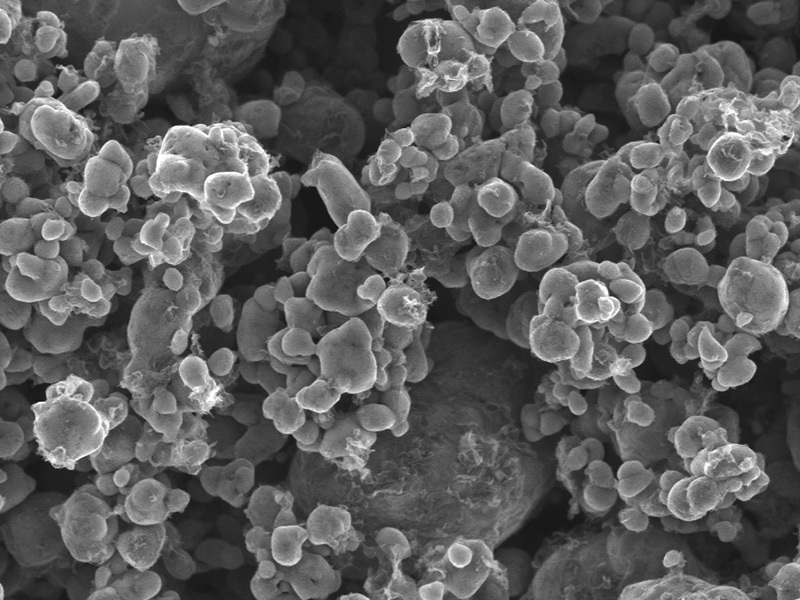
The smaller the particle size of the lithium iron phosphate material, the larger its specific surface area per unit volume and the shorter the ion diffusion pathways become. This implies that lithium ions can intercalate into or deintercalate from the material more rapidly during the charge-discharge process, thereby enhancing the battery's high-rate performance. Small-particle-size materials typically lead to significant improvements in capacity retention and power output capabilities under rapid charging and discharging conditions, making them particularly well-suited for electric vehicles and high-rate energy storage applications.
II. The Trade-off Between Particle Size and Energy Density
Although small-particle-size materials demonstrate superior performance in terms of charge-discharge rates, excessively small particle sizes increase the specific surface area of the battery's active material. This renders the material more susceptible to side reactions with the electrolyte, leading to accelerated capacity decay and, consequently, compromising the battery's cycle life. Therefore, in the design of battery materials, it is essential to strike a balance between high-rate performance and energy density. Typically, by optimizing the particle size distribution, manufacturers can maintain a high energy density while simultaneously ensuring rapid charge-discharge capabilities.
III. The Impact of Particle Size on Cycle Life
Particle size also directly influences the battery's mechanical stability and structural integrity. Large-particle-size materials exhibit relatively minimal volume expansion and contraction during cycling, thereby maintaining good structural stability; however, ion diffusion within them is slower. Conversely, while small-particle-size materials facilitate rapid diffusion, they are more prone to particle pulverization during prolonged cycling, which can result in a decline in capacity. By combining precise particle size control with surface coating technologies, the cycle life of lithium iron phosphate batteries can be effectively extended.
IV. Particle Size Optimization in Industrial Applications
In actual manufacturing processes, the particle size of lithium iron phosphate materials is typically controlled through techniques such as wet chemical precipitation, spray drying, or high-temperature sintering. When designing batteries, manufacturers select specific particle size specifications based on the intended application scenario—such as electric vehicles, grid-scale energy storage stations, or consumer electronics—in order to achieve an optimal balance among high-rate performance, cycle life, and cost efficiency. This particle size optimization strategy serves as a crucial means of enhancing the overall performance of lithium iron phosphate batteries.
The particle size of lithium iron phosphate materials exerts a profound influence on battery performance. The judicious control of particle size not only boosts charge-discharge rates and energy density but also extends cycle life, thereby meeting the diverse requirements of various application scenarios. Through the optimization of material particle size design, lithium iron phosphate batteries are poised to deliver even more exceptional performance in both power battery and energy storage applications.

Comments
Post a Comment