Performance comparison of Liquid Cold Plates with different structures
The structural forms of Liquid Cold Plates are diverse, and there are significant differences in heat dissipation performance between different structures.
First of all, the Liquid Cold Plate with a parallel flow channel structure is a more common one. The advantage of this structure is that the liquid flows more regularly and can achieve more stable heat transfer. The parallel flow channels inside it make the pressure loss of the liquid relatively small when it flows through, and can take away heat at a more uniform flow rate. However, its disadvantage is that the temperature difference of the coolant may be large near the inlet and outlet, resulting in uneven heat dissipation and local overheating in high heat density areas.
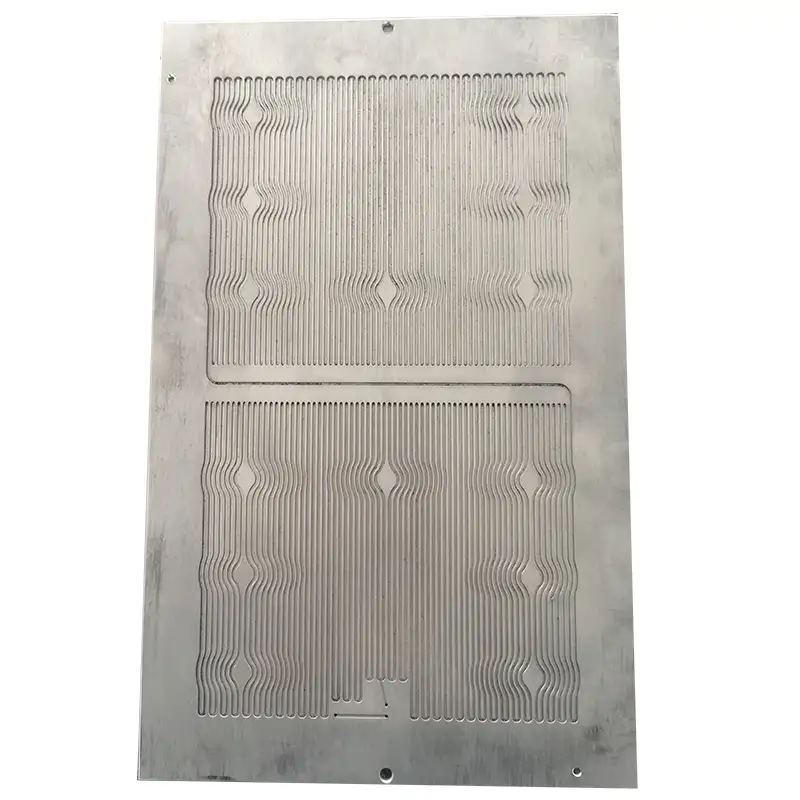
The Liquid Cold Plate with a serpentine flow channel structure has different characteristics. The serpentine flow channel can increase the residence time of the coolant in the Liquid Cold Plate, allowing the coolant to absorb heat more fully. This structure has a better heat dissipation effect for local high heat sources because it allows the coolant to have more opportunities for heat exchange in high heat areas. However, the serpentine flow channel also has shortcomings. Due to the large number of bends in the flow channel, the resistance to liquid flow is large, and a larger pumping power is required to maintain the circulation of the coolant, and local pressure instability is easily formed at the bends.
The Liquid Cold Plate with a microchannel structure shows unique advantages in heat dissipation performance. The microchannel greatly increases the contact area between the coolant and the heat source, which can achieve efficient heat conduction. This structure is very suitable for high power density heat dissipation needs, such as in the heat dissipation scenarios of some high-performance chips. However, the processing of the microchannel structure is difficult and costly, and the purity of the coolant and the stability of the pumping system are more stringent. Once the channel is blocked, the heat dissipation performance will be seriously affected.
Liquid Cold plates of different structures have their own advantages and disadvantages in heat dissipation performance. In practical applications, it is necessary to comprehensively consider factors such as specific heat dissipation requirements, cost budget, and space constraints to select the most suitable Liquid Cold plate structure to achieve the best heat dissipation effect.

Comments
Post a Comment